Part One — The Biology of Hair
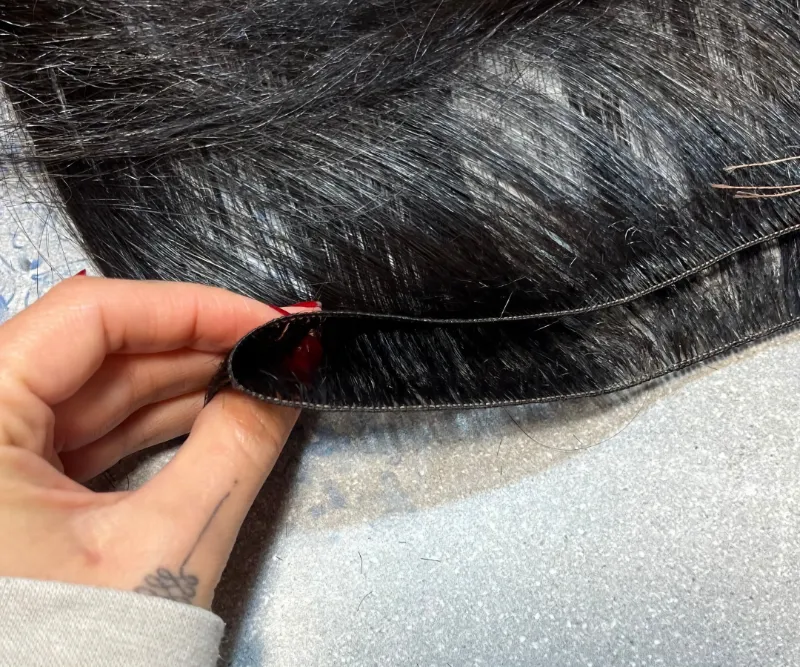
When you touch a ponytail and it slides smoothly between your fingers from root to tip, you are feeling an intact cuticle. That sensation is not cosmetic. It is structural information about the condition of the hair.
Last Updated: 22 July 2026 ■ 4 min read
Understanding Hair Before You Buy Any of It
To make good decisions about hair extensions — to source well, to install correctly, to maintain intelligently — it helps to understand what hair actually is. Not in exhaustive biochemical detail, but well enough to recognise what you are looking at and why it behaves the way it does.
Structure: What Hair Is Made Of
Each hair strand has three concentric layers. The innermost is the medulla — a soft core present in thicker hair types, often absent in fine hair. Around it sits the cortex, which makes up the bulk of the strand and contains the melanin granules responsible for colour, as well as the keratin proteins that give hair its strength and elasticity. The outermost layer is the cuticle: a series of overlapping, scale-like cells that lie flat against the strand when the hair is healthy, protecting the cortex beneath.
The cuticle is what you are actually reading when you run your fingers along a strand of hair. Hair that feels smooth root to tip has its cuticle scales lying flat and intact. Hair that feels rough or catches has scales that are lifted, damaged, or disrupted — either by chemical processing, mechanical stress, heat, or environmental exposure.
When you touch a ponytail and it slides smoothly between your fingers from root to tip, you are feeling an intact cuticle. That sensation is not cosmetic. It is structural information about the condition of the hair.
Cuticle Direction and Why It Matters for Extensions
In a natural, uncut strand of hair, the cuticle scales all point in the same direction: from root toward tip, like the scales of a fish. This directionality is not visible to the eye, but it is what allows natural hair to move smoothly, resist tangling, and reflect light evenly.
When hair from multiple donors is blended — as it is in most factory-processed extension hair — strands from different people with different cuticle orientations are mixed together. The result is constant microscopic friction between strands, which causes tangling, matting, and accelerated degradation.
To solve this problem, many manufacturers strip the cuticle entirely using acid baths, then coat the hair in silicone to restore the appearance of smoothness. The result looks healthy in the packaging. Within a few weeks of use and washing, the silicone wears off, and what remains is structurally compromised hair that tangles, breaks, and cannot be restored.
Single-donor hair retains its original cuticle orientation throughout, because all strands came from the same head in the same direction. This is the primary structural reason why single-donor hair behaves fundamentally differently from blended hair — and why the difference becomes most visible over time, not immediately.
Porosity: The Property That Determines Everything Else
Porosity describes how readily a strand of hair absorbs and retains moisture. It is determined by the condition of the cuticle layer: tightly closed cuticles mean low porosity; raised or damaged cuticles mean high porosity. Low porosity hair resists moisture absorption but retains it well once absorbed. High porosity hair absorbs moisture quickly but loses it just as fast. Both have implications for how extensions should be selected and maintained.
Understanding your own porosity — and that of the hair you are integrating — directly determines which products will work, how the hair will behave after washing, and how the blending of natural hair and extensions will hold up over time.
Melanin: Natural Colour and What It Tells You
Hair colour is produced by melanin granules in the cortex. There are two types: eumelanin, which produces brown and black tones, and pheomelanin, which produces red and yellow tones. All natural hair colours are combinations of these two in varying proportions.
Exposure to UV light oxidises melanin, which is why hair naturally lightens toward the ends — those strands have been exposed to sunlight for longer than the newer growth at the root. This natural gradient — darker at the root, lighter at the tips — is one of the clearest markers of genuinely unprocessed hair.
Mechanical Stress, Tension, and Long-Term Scalp Health
Hair follicles are living structures that respond to their environment. Chronic tension — applied through tight braiding, heavy extensions, or repeated mechanical stress at the same points — can damage the follicle over time, leading to traction alopecia: progressive, and in advanced cases irreversible, hair loss along the hairline and crown.
This is why installation method matters as much as the quality of the hair being installed. The NOISM Braided Base method is specifically designed to distribute weight evenly across the scalp, work across all hair textures, and protect follicular health over long wear periods. The base is not an afterthought. It is the foundation the entire system rests on.