Part Two — The NOISM Method
What NOISM has developed is not a reinvention of this history. It is a refinement — a specific technical execution built on the original principle, adapted to work across all hair textures and specifically engineered to meet the demands of premium single-donor hair and hand-tied weft installation.
Last Updated: 22 July 2026 ■ 12 min read
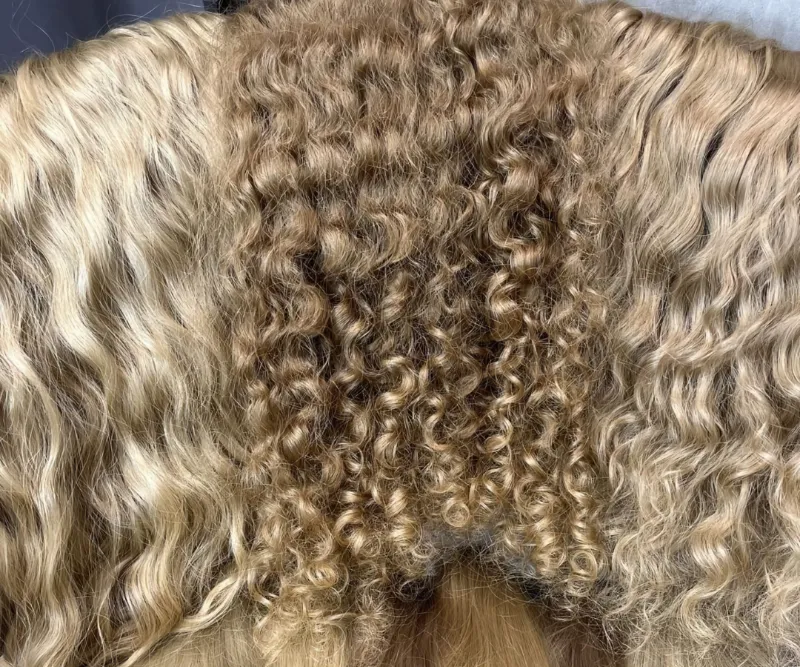
The Braided Base: Foundation, Function, and Philosophy
The Braided Base is NOISM's proprietary installation foundation — the structural layer between the client's natural hair and the weft. It is what makes everything else possible: the longevity, the comfort, the scalp access, the ability to air-dry, and the absence of traction damage. Understanding it is essential to understanding why this system performs differently from anything else on the market.
The History and Origin of the Method
The braided base sew-in as a concept has existed since at least the mid-twentieth century. The foundational technique — braiding the natural hair flat against the scalp, then sewing a weft onto the braid — was developed and patented in the United States, and it has been part of Afrocentric hair culture for decades. The single-row sew-in, in particular, is a technique that has deep roots in Black hair traditions and is currently experiencing renewed interest as a lower-manipulation alternative to full head installations.
What NOISM has developed is not a reinvention of this history. It is a refinement — a specific technical execution built on the original principle, adapted to work across all hair textures and specifically engineered to meet the demands of premium single-donor hair and hand-tied weft installation.
There is an important distinction that NOISM draws, and that does not appear widely in the industry: the difference between decorative braiding and functional braiding. Decorative braiding is braiding for aesthetic effect — for appearance, for adornment, sometimes for protective styling. Functional braiding is braiding as engineering — where the structure of the braid is the foundation of what is built on top of it, and where specific technical properties of the braid determine the safety, longevity, and comfort of the installation. The Braided Base is functional braiding. The criteria are entirely different.
Why No Adhesives, Heat, or Mechanical Fasteners
The Braided Base sew-in is the only major installation method that achieves its hold through purely mechanical means — no glue, no heat bonding, no welding, no chemical adhesives, no microring crimping directly on the natural hair. The entire structural integrity of the installation rests on the braid itself and on the thread that secures the weft to it.
This matters for several reasons. Adhesives and heat-based bonds degrade over time and must be broken to remove — a process that, regardless of the product used, applies stress to the natural hair at the bond site. The Braided Base does not degrade in this way. Removal is a technical reversal of the installation: the thread is cut, the weft is lifted, and the braid is released. The natural hair underneath has experienced no chemical or thermal intervention. Nothing needs to be dissolved, melted, or cut away.
For single-donor hair that will be reinstalled multiple times across years, this is the only logical approach. Every other removal method introduces a variable that accumulates over cycles.
Construction: How the Base Is Built
For Stylists
The following describes the technical construction of the Braided Base. This section is written for practitioners and stylists seeking to understand or learn the method.
Braid direction and placement The braids are placed horizontally across the scalp, following the natural growth pattern of the client's hair. This horizontal orientation is not arbitrary — it determines how the weft will lie and how the weight will distribute across the head. Rows are spaced to match the density and volume of the client's natural hair, and their placement is mapped before braiding begins.
Braid width and density formulas One of the defining features of the NOISM Braided Base is that braid width is calculated, not estimated. The width of each braid — its structural mass — is determined by the density and texture of the client's hair using specific formulas developed through years of cross-textural practice. A braid that is too thick for a fine-haired client creates unnecessary tension and bulk. A braid that is too thin for a thick-haired client will not provide sufficient anchor for the weft weight. These formulas ensure that the base is always appropriately sized for the individual — that it lies flat, distributes weight evenly, and does not create localised tension at any point on the scalp. This is what makes the method applicable across all hair types: fine, medium, coarse, straight, wavy, curly, and tightly coiled.
The flat braid technique The specific braiding technique used in the Braided Base is visually distinct from standard cornrow braiding and is not widely known outside of NOISM's training programme. The braid is constructed to remain exceptionally flat against the scalp — flatter than a standard cornrow, with a specific internal structure that affects how it sits, how it grows out, and how evenly the attachment distributes across its length. This flatness is not cosmetic. It is what allows the weft to lie flush, what prevents the installation from being visible or detectable at the root, and what makes air-drying possible. A base with any significant height creates a gap between the weft and the scalp — that gap traps moisture, creates pressure points, and becomes visible through the natural hair over time.
Securing the braid Braids are secured at the ends using either specialist elastic bands or aluminium micro-beads, depending on the client's hair type and care habits. Micro-beads are preferred in cases where heat tool use is likely, since elastic bands can be weakened or snapped by direct heat contact. The choice of fastener is made at consultation based on a realistic assessment of how the client actually manages their hair day-to-day — not based on how they intend to manage it.
Weight Distribution
Weight distribution is one of the most underappreciated aspects of extension installation, and one of the primary sources of long-term scalp damage in the industry. Most installation methods concentrate weight at specific anchor points — the bond site, the ring, the tape seam. Over time, the constant downward pull of extension hair on these localised points creates tension in the follicle. This is the mechanism behind traction alopecia: not a single catastrophic event, but the slow accumulation of force at the same points, day after day, through growth cycles.
The Braided Base distributes the weight of the weft across the entire length of the braid — not at a point, but along a line. The weft is sewn continuously along the braid, meaning the load is shared across every attachment point simultaneously. No single follicle bears a disproportionate share of the weight. This is the architectural logic of the method. A bridge distributes load across its entire span. The Braided Base distributes the weight of the extension across the entire braid. The scalp underneath experiences far less localised stress than any point-anchor system produces.
The goal of the Braided Base is not simply to hold the weft in place. It is to hold it in place in a way that the scalp can sustain indefinitely — across years of wear, removal, and reinstallation — without accumulating damage.
Scalp Access
One of the defining practical advantages of the Braided Base over full head sew-in methods — such as the VOHC method widely used in Afrocentric extension practice, where the entire head is braided before wefts are applied — is that the scalp remains substantially accessible between the rows.
This accessibility has direct consequences for scalp health. The skin of the scalp needs to breathe, to be cleaned, and to receive topical products — sebum regulators, moisturisers, growth treatments — directly, not through several centimetres of braided hair. In a full head installation, this access is dramatically reduced. In the Braided Base single-row system, the scalp between rows is fully exposed and reachable.
This means that maintenance appointments can include actual scalp treatment, not just surface conditioning of the weft hair. And it means that clients with scalp conditions — dryness, sensitivity, buildup — can continue to address them while wearing the installation.
Washing
The ability to wash the hair properly while wearing extensions is not a minor convenience — it is a clinical necessity. Scalp buildup, product residue, and sebum accumulation are the primary drivers of follicle inflammation and long-term scalp damage in long-term extension wearers.
The Braided Base, when constructed correctly, allows water and product to pass through the installation and reach the scalp. The braids are fine enough, and spaced appropriately enough, that water flows through rather than sitting on top. This is the result of both the specific braiding technique and the braid width calculations — a braid that is too thick creates a barrier; a correctly sized braid creates a permeable structure.
Clients receive specific washing protocols at installation — not generic advice, but instructions matched to their hair type, their scalp condition, and the specific construction of their base. These protocols specify product type, application method, water temperature, and technique. Following them is not optional. The longevity of the installation depends on consistent, correct washing.
Common washing errors
- Vigorous scrubbing or circular motion at the scalp — this displaces the braids and disrupts the attachment over time
- Applying shampoo directly to the weft hair rather than to the scalp — weft hair requires conditioning, not repeated shampooing
- Insufficient rinsing — product residue is a primary cause of scalp irritation and buildup under extensions
- Washing too infrequently — the scalp continues to produce sebum at its normal rate regardless of extensions; buildup is a health issue, not merely a cosmetic one
Drying
The drying behaviour of the Braided Base installation is one of the features that most consistently surprises clients who have worn other extension methods. Because the base lies flat, because the braids are correctly sized for the client's density, and because hand-tied wefts add virtually no structural bulk above the scalp — the entire installation can air-dry completely. No diffuser required. No sitting under a hooded dryer. No accepting that the inner layers will remain damp for hours.
This is significant. Persistent moisture at the scalp — the condition that results when a construction is too dense, too thick, or too high-profile to allow air circulation — creates an environment conducive to bacterial and fungal growth. It is uncomfortable, it is unhygienic, and it accelerates the deterioration of both the weft and the natural hair beneath it.
The combination of the Braided Base and hand-tied wefts eliminates this problem by design. The construction is thin enough that air moves through it. The weft hair dries from the outside in, and the scalp — fully accessible between rows — dries from the inside out. The meeting point is reached within a reasonable time frame, even for clients with significant hair volume.
The ability to air-dry completely is not a minor comfort feature. In the context of long-term extension wear, it is a health condition — one that most other installation systems cannot meet and that this combination addresses structurally.
Traction and Long-Term Scalp Health
The Braided Base is specifically engineered to produce zero traction-induced damage when constructed correctly and maintained appropriately. This claim rests on three structural properties:
- Weight distribution along the braid rather than at attachment points — eliminates the localised follicular stress that drives traction alopecia
- Braid width calibrated to the client's hair density — prevents the tight, high-tension braiding that characterises damaging installations
- Horizontal placement following the natural growth direction — works with the hair's directional tendency rather than against it
Traction damage in extension wearers is almost never caused by a single event. It is the product of cumulative, chronic, low-level tension at the same follicular sites, compounded over months and years. The Braided Base addresses this at the architectural level — not by adding a topical treatment or a maintenance step, but by changing the mechanical reality of how the load is held.
For Stylists
For practitioners: the most common technical error in Braided Base construction is braiding too tightly in an effort to create a more secure anchor. A tighter braid does not produce a more secure installation — it produces a more painful one, and one that will cause follicular stress over time. The security of the installation comes from the thread and the weft construction, not from the tension of the braid. The braid should lie flat and feel comfortable immediately after installation. If a client reports pulling or discomfort within the first 24 hours, the tension is too high.
Maintenance and Longevity
The Braided Base grows out with the natural hair. As the client's own hair grows, the braids move away from the scalp, and the wefts move with them. At a certain point — typically every 6 to 10 weeks depending on the individual's growth rate and hair type — the installation is removed, the natural hair is assessed and treated if needed, the braids are redone at the new root level, and the same wefts are reinstalled.
This cycle can repeat for years. The wefts do not shorten. The natural hair does not lose length. The installation does not degrade from cycle to cycle. What determines how many cycles a set of wefts can sustain is the care they receive between appointments — both the client's home maintenance and the professional's handling at each removal and reinstallation.
- Remove and reinstall only with a practitioner trained in this method — the thread must be cut, not pulled
- Never attempt self-removal — the risk of cutting or tangling the natural hair is significant for anyone unfamiliar with the construction
- At each reinstallation appointment, the natural hair should be assessed for health before the base is redone — this is not optional, it is part of the service
- The wefts themselves should be washed, conditioned, and inspected at each reinstallation — they are a long-term investment and should be treated as one
When all of these conditions are met, a hand-tied weft set installed on a correctly constructed Braided Base is among the most conservative, most protective, and most durable extension systems available. Not despite being labour-intensive and technically demanding — because of it.