Reference – Glossary of Terms
The hair extension industry uses terminology inconsistently — the same word can mean different things from one brand to the next. The definitions below reflect their meaning as used in this handbook and in professional single-donor practice.
Last Updated: 22 July 2026 ■ 7 min read
Terminology
The hair extension industry uses terminology inconsistently — the same word can mean different things from one brand to the next. The definitions below reflect their meaning as used in this handbook and in professional single-donor practice.
Acid Bath / Acid Wash
A chemical treatment used by many manufacturers to strip the cuticle from collected hair, removing its natural directionality and texture variation. After stripping, the hair is typically coated with silicone to restore the appearance of smoothness. Structurally compromises the strand permanently. See also: Silicone Coating.
Afro-Textured Hair
A broad category describing hair with a tightly coiled or kinked growth pattern. Within this category there is significant variation in curl diameter, density, and behaviour. In the single-donor market, Afro-textured hair in long lengths is among the rarest and most sought-after categories globally.
Braided Base
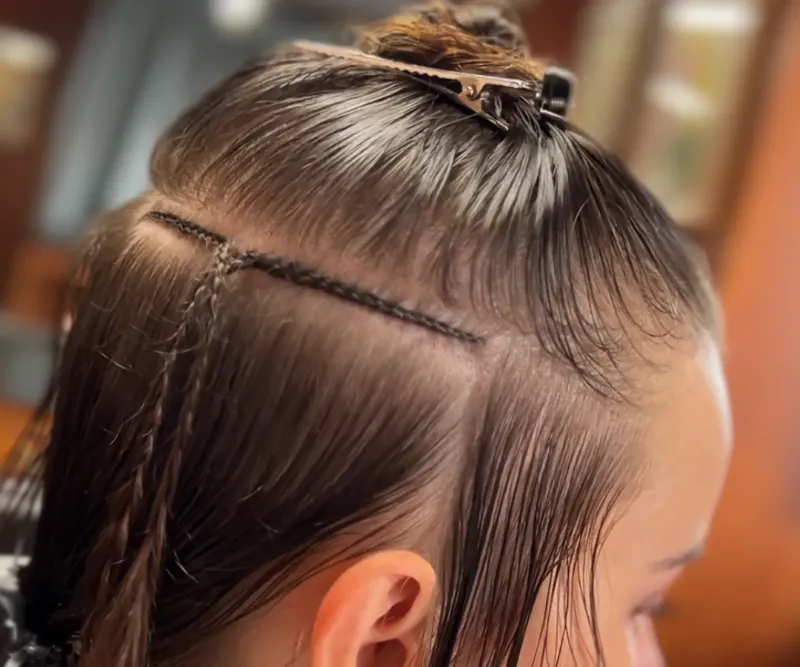
NOISM's proprietary installation foundation — a flat, functionally braided structure onto which hand-tied wefts are sewn. Designed to distribute weight evenly along its length rather than at anchor points, allow full scalp access between rows, work across all hair textures, and support air-drying. Distinguished from decorative braiding by its engineering criteria rather than aesthetic ones.
Collector
A specialist who builds direct relationships with donors in a specific geographic region, assesses ponytails individually before purchase, and sells single cuts directly to stylists or ateliers. The quality and ethics of the collector relationship are a significant determinant of the quality of the hair at the end of the supply chain.
Cuticle
The outermost protective layer of a hair strand, composed of overlapping scale-like cells running from root to tip in healthy, unprocessed hair. An intact cuticle lies flat, reflects light evenly, and allows strands to move smoothly past each other. A damaged or stripped cuticle results in roughness, tangling, and accelerated degradation.
Cuticle-Aligned Hair
Hair in which the cuticle scales all run in the same direction — root to tip — throughout the batch. Single-donor hair is inherently cuticle-aligned because all strands originate from the same head. Prevents the microscopic friction that causes tangling in blended hair.
Decorative Braiding
Braiding performed for aesthetic effect — for appearance, adornment, or protective styling. Distinguished from functional braiding by its criteria: in decorative braiding, the primary evaluation is visual. See also: Functional Braiding.
Density (Hair)
The concentration of individual strands per unit of scalp area. High-density hair is visually full and voluminous at the root. In a premium ponytail, density is consistent from root to tip — not front-loaded at the root and sparse toward the ends. Not to be confused with strand thickness, which is a separate property.
Double Drawn
A processing technique in which shorter hairs are systematically removed from a collected batch, resulting in hair that appears uniformly thick from root to tip. Double-drawn hair typically comes from multiple donors and is not single-donor hair. Frequently mislabelled as premium. See also: Single Drawn.
Donor
The person from whom the hair was cut. In ethical single-donor sourcing, the donor is aware of the commercial use of their hair, has consented to its sale, and has been compensated. The origin and ethics of the donor transaction are part of what distinguishes premium single-donor hair from lower-quality supply chains.
Functional Braiding
Braiding performed for structural and engineering purposes rather than aesthetic ones. In functional braiding, the criteria are safety, even weight distribution, scalp access, and the ability to sustain the demands of a long-term installation. The NOISM Braided Base is functional braiding. See also: Decorative Braiding.
Hand-Tied Weft
A hair weft in which individual strands are tied by hand onto a thin, flexible base using needle and thread. No machines, adhesives, or heat involved in construction. Production takes 25–50 hours per set. Hand-tied wefts cannot be cut with scissors without the spine unravelling.
Keratin
The primary structural protein of the hair strand, found in the cortex. Gives hair its tensile strength, elasticity, and resilience. Degraded by chemical processing, heat, and mechanical stress over time.
Machine Weft
A hair weft produced by industrial stitching equipment. Significantly less expensive to produce than hand-tied wefts. Has a thicker, stiffer construction and a sealed edge that can be cut without unravelling. Not compatible with the same installation methods as hand-tied wefts.
Melanin
The pigment responsible for hair colour, produced in the hair follicle and deposited into the cortex during growth. Two types: eumelanin (brown/black) and pheomelanin (red/yellow). UV exposure degrades melanin over time — which is why hair naturally lightens toward the ends.
Ponytail / Single-Donor Cut
The raw material of single-donor hair: hair gathered, secured, and cut from one person's head in a single uninterrupted cut. Preserves the root-to-tip cuticle orientation of every strand. Never blended with hair from other donors.
Porosity
A measure of how readily a hair strand absorbs and retains moisture, determined by the condition of the cuticle. Low porosity: tightly closed cuticle, resists moisture entry but retains it well. High porosity: open or damaged cuticle, absorbs quickly but loses moisture just as fast. Affects product selection, drying behaviour, and extension compatibility.
Raw Hair
Hair that has not undergone any chemical processing. Retains its original cuticle, colour, and structural integrity. All genuine single-donor premium hair is raw. The term is sometimes misused in marketing; the reliable test is whether the cuticle is intact and the colour is the donor's natural colour.
Remy Hair
Hair in which the cuticle direction is maintained consistently — all strands running root to tip. A quality descriptor, not a sourcing claim. Single-donor hair is inherently Remy, but not all Remy hair is single-donor. The term has been widely diluted through misuse.
Silicone Coating
A surface treatment applied to processed or acid-washed hair to temporarily restore smoothness and shine. Wears off within weeks of regular washing, after which the underlying structural damage to the cuticle becomes apparent. Genuine unprocessed single-donor hair does not require silicone coating.
Single Donor
Hair sourced from one individual, cut in a single session, without blending with hair from other heads. Retains its original structural integrity, cuticle alignment, colour gradient, and behavioural consistency. The highest standard of traceability in the extension market.
Single Drawn
Hair that includes the full range of lengths naturally present in the donor's ponytail, including shorter strands. Tapers toward the ends as a result. The natural state of a genuine ponytail before any additional processing. Compare with Double Drawn.
Traction Alopecia
Hair loss caused by chronic tension applied to the hair follicles — most commonly from tight braiding, heavy extensions, or repeated mechanical stress at the same points. Early-stage presents as thinning and breakage along the hairline or crown. In advanced cases, follicular damage can be permanent. Correct installation technique and appropriate weight distribution are the primary preventive measures.
Virgin Hair
Hair that has never been chemically treated. May come from a single donor or from multiple donors. Virgin + single-donor is the combination that defines the premium standard.
Weft
A length of hair bound along one edge — by hand-tying or machine stitching — to create a structured strip for installation. The quality of the weft construction determines how the hair behaves, how long it lasts, and how it can be maintained and removed.
Questions before you commit? That is what the consultation is for.